

Maitake-by-the-Sea
If not a breach, what is it?


You’re reading the first story in Generation, Tractor Beam’s Spring 2025 issue. You can read the remaining stories here. Subscribe to receive future Tractor Beam issues in your inbox as soon as they drop!
Story by: Renan Bernardo
Art by: Sajan Rai
Reading Time: 15 minutes
Read in Portuguese
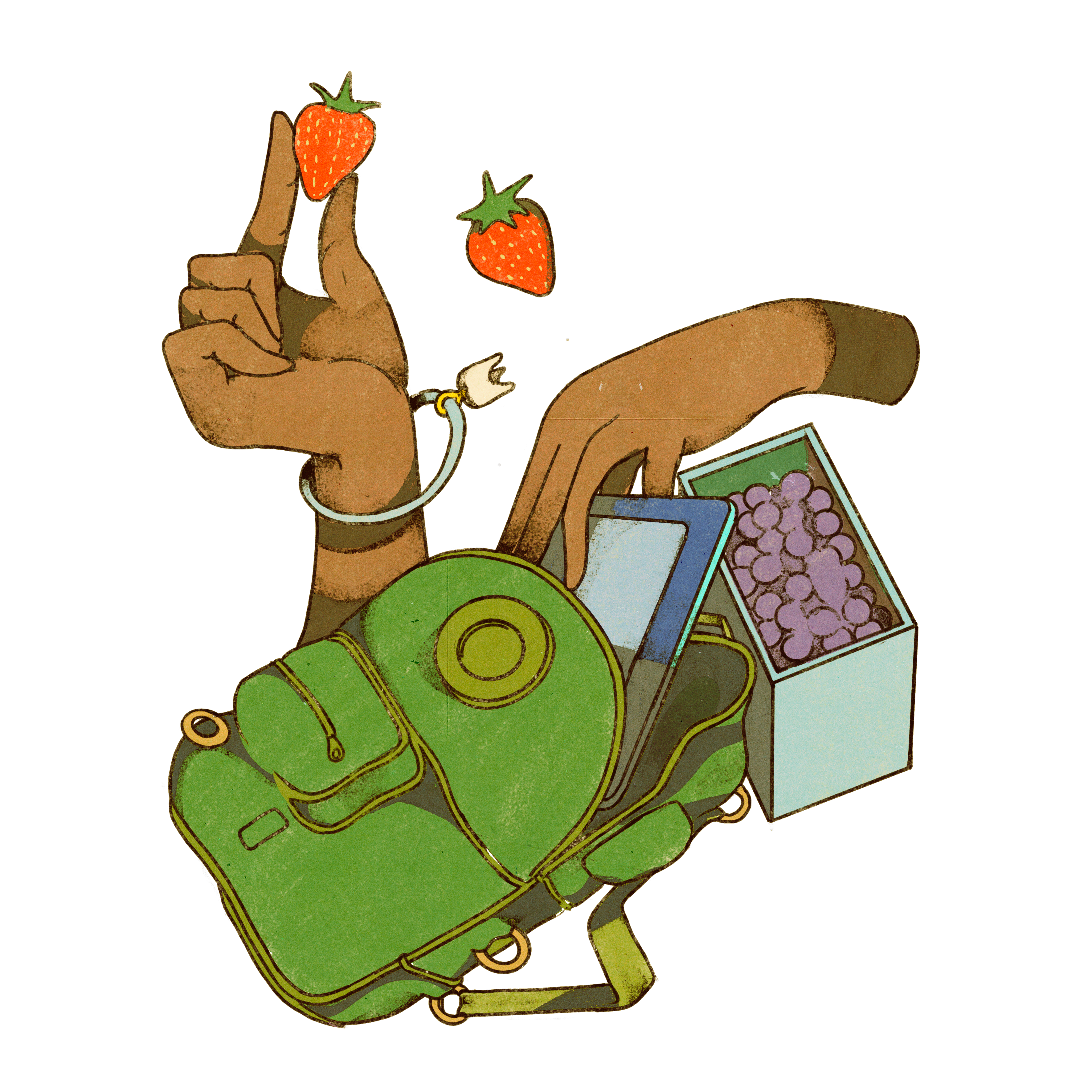
“The walls have been breached…” Giovanni’s audio message is anxious. Adri packs her things hastily—her pad, a box of blueberries for Giovanni, and the bracelet with Mama’s molar fastened to it—pops two strawberries in her mouth and rushes down the stairs, her heart racing.
“Ha, good one,” she audios Giovanni back. It must be a joke—the walls of Maitake can’t be breached. She mounts her bike and pedals.
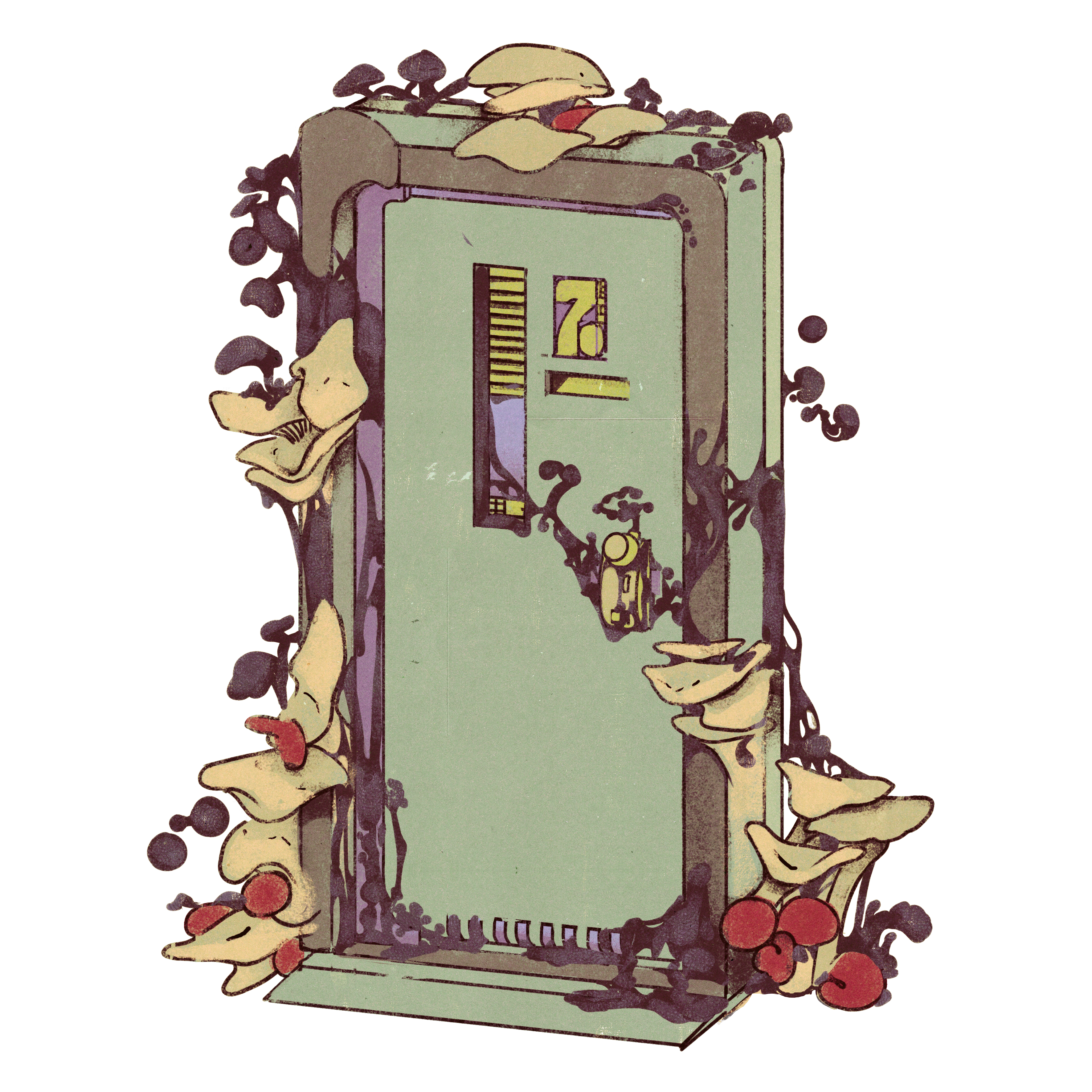
As soon as she crosses the buffer zone onto Freulick Street, she sees the facade and walls of two houses mottled with dark, wilted mushrooms. They stand in stark contrast to the sturdy caps of the Oyster and Reishi mushrooms that ordinarily grow there. Even the doors have been overtaken by the misshapen fungi, which form a chaotic pattern around their knobs. One of the residents, leaning out his window, trims away the overgrowth from inside with pruning shears. The act seems pointless.
The collectors are sitting on the sidewalk with their baskets, murmuring to each other, casting inquisitive looks at Adri, Giovanni, and the duo of agritects he’s brought along to assess the situation.
“No joke, huh…” Adri mumbles.
“It’s a pathogenic fungus,” Giovanni says, not raising his head from his pad. “Biohacked into the walls.”
“It’s a pathogenic fungus,” Giovanni says, not raising his head from his pad. “Biohacked into the walls.”
“Spores?” Adri asks, fetching her pad and opening Maitake’s map.
Giovanni nods. Adri sighs and hands him the box of blueberries.
“Eat them while you still can.”
Adri is the food manager of Maitake, responsible for distribution, not the edibility or quality of its produce. And though she is one of the original designers of the walls, today the task of managing them belongs to agritects like Giovanni. If a pathogen is spreading through the plant and fungal life growing on the town’s walls, that means food scarcity. And scarcity means unrest—or worse.
She assesses the other houses on the street. She needs to calculate how long they have until things get really bad. They’re in the District of Shrooms, where the walls are dedicated to growing edible and functional fungi species. The district stands apart from the other Maitakian neighborhoods, separated by buffer zones with airlocks to prevent cross-contamination. Perhaps there’s still hope—at least for the other districts.
Adri slumps on the sidewalk, her back to the contaminated walls. She folds her knees and rests her head in her hands.
This should never have happened. They should’ve been protected. She’s read the papers, the technical agritect reports about the silver nanoparticles that inhibit microbial growth, about the humidity and temperature controls, about the pest management tools. The systems have been showing all stats as healthy.
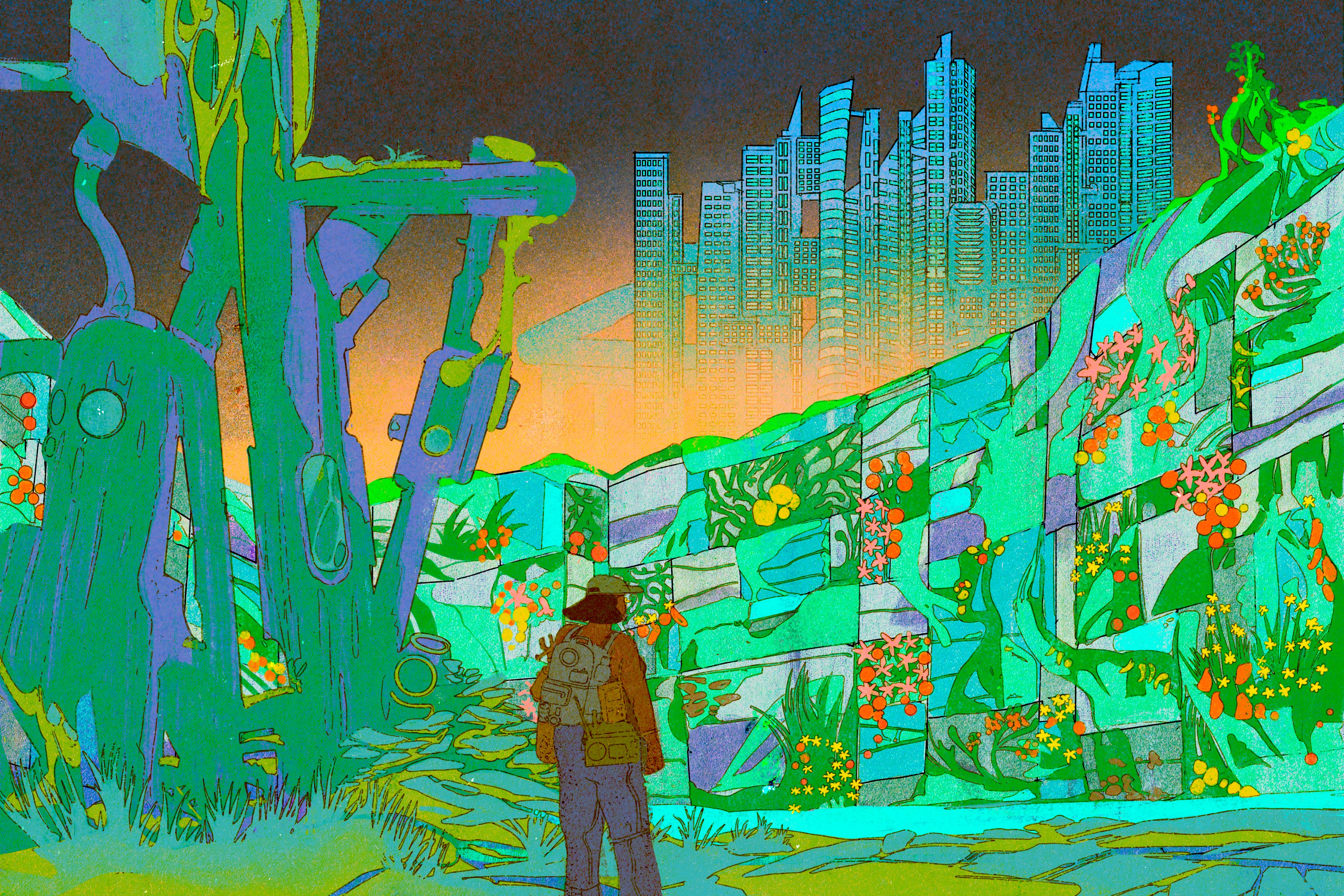
The renowned walls of Maitake had been her idea. But it was only when a group of young microclimate and biotech engineers arrived from the capital for internships that the feasibility of her idea was put to the test. Made of a substrate of resistant polymers mixed with layers of organic material engineered to host a variety of edible plants and fungi, the Maitakian walls are thicker than stone; within, smart hydroponic and aeroponic systems work to nourish the food that grows on them. Mycelial networks thrive within the substrate. With buffer zones, environmental sensors, artificial rain, and towers to balance the nutrients of each neighborhood, the town was able to “bypass” the Great Drought.
“The good news is…” Giovanni crouches by her side and shows her the display of a sequencing rod he has grabbed from one of his colleagues. “The hacker made a mistake. It stinks of Saint Lazarus.”
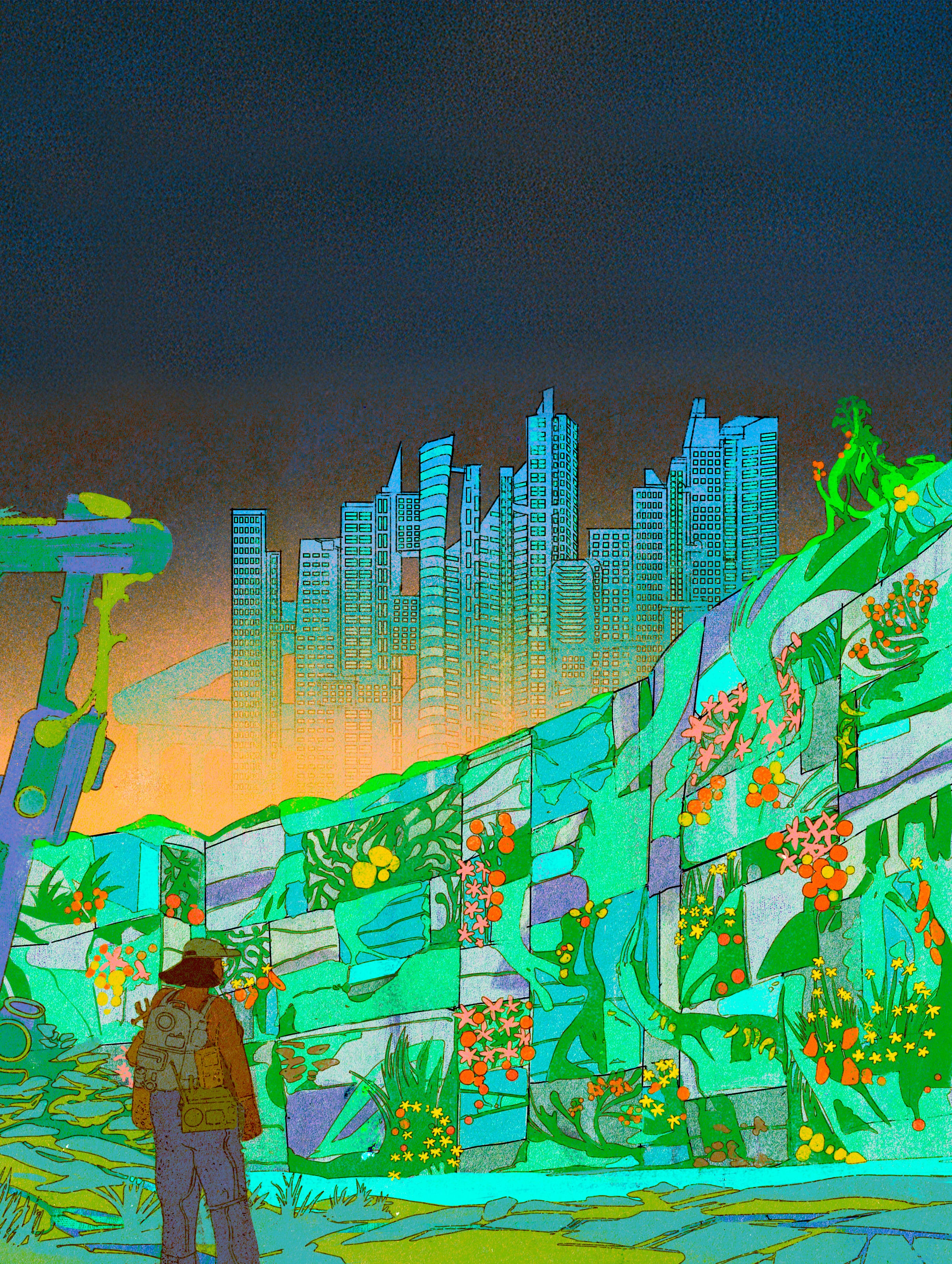
From a distance, Maitake’s houses look straight out of a fairy tale—their walls made of strawberries, blueberries, lettuce, arugula, cucumbers, zucchini, beets, and a vast assortment of mushrooms and herbs. Young folks push handcarts through the fragrant streets, plucking from the walls food that later will appear on their sisters’, grannies’, and friends’ tables. Small groups of collectors cross the buffer zones on electric scooters, carrying in baskets laden with production surplus waiting to be sent to nearby towns in need. From the windows, elderly ladies reach out to wave and pluck strawberries from baskets that dare to get too close. “To give us luck,” they say.
And there’s always an old man sitting in a plaza, just waiting until some unsuspecting child ambles by to remind the younger generation how good they have it in Maitake these days.
The town wasn’t always called Maitake. Twenty years ago, it was known as Rockstrak, and Adri was a single child raised by her mother among her boisterous cousins, Giovanni, Gina, Taylor, and Alves.
Adri was set on going to a university and studying something—anything. Robotics. Food Engineering. Genetics. When Mama was tipsy, she listened to Adri in silence. Sometimes Adri glimpsed a smile on her face, a kind of shy audacity as she let herself dream her daughter’s dreams. But when Mama was sober, she just grunted and shook her head. What use were the pipe dreams of a little girl living through the Great Drought, when even the emergency crops shriveled up, and when even the price of packaged food soared?
What use were the pipe dreams of a little girl living through the Great Drought, when even the emergency crops shriveled up, and when even the price of packaged food soared?
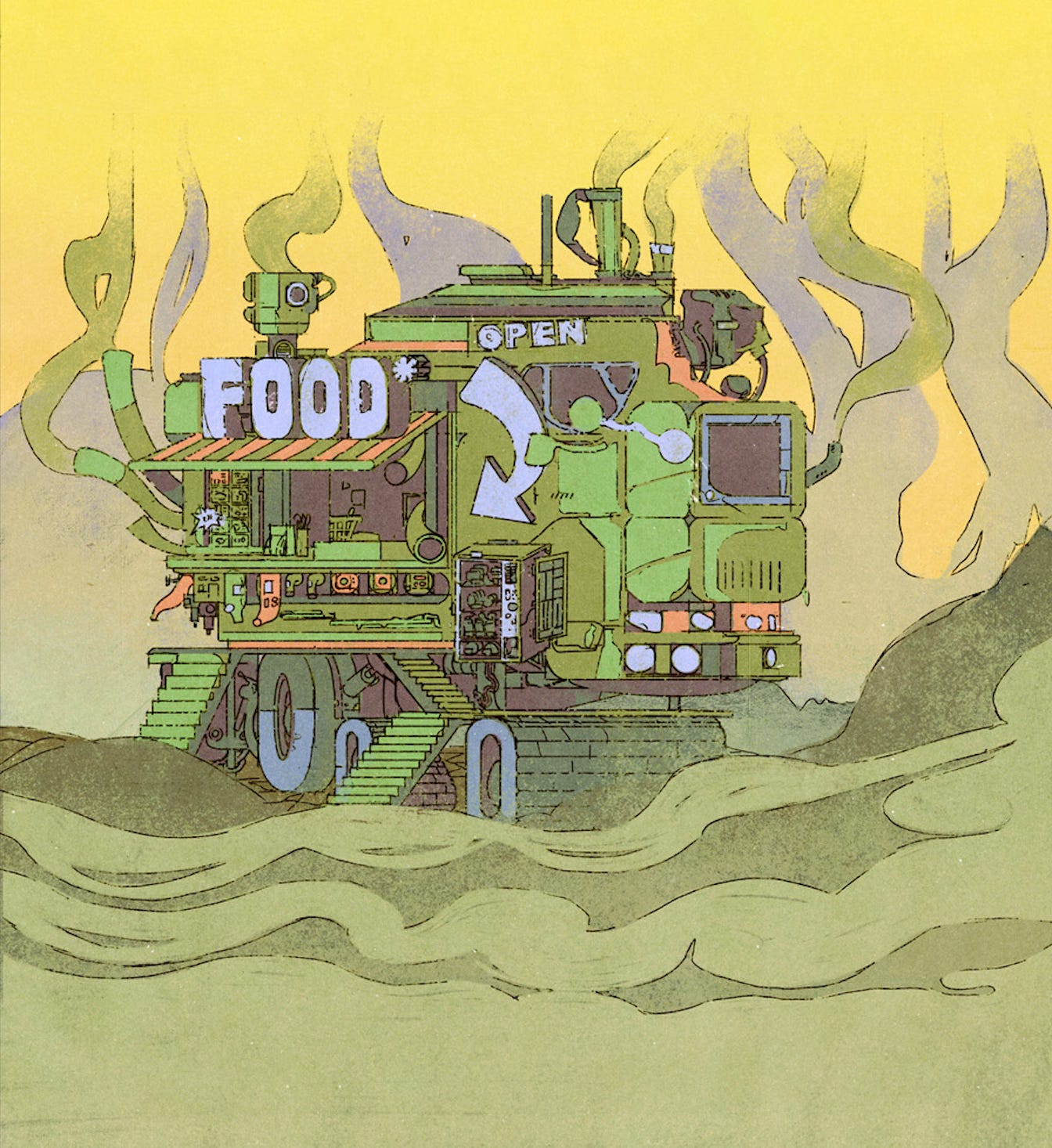
The trouble with Saint Lazarus is that it smells too much like her past. Adri plods along the concrete in thick-soled boots, absorbing the familiar stench of smog and food trucks frying too many different things at once. Even the air is sticky.
The streets are packed tight with stone-built houses, clinging to each other as if craving touch. From above, Saint Lazarus looks like a crumbling, neglected mosaic. Its population, ever fearful of foreigners, seems always to be peeking out from behind the curtains.
Saint Lazarus has been going down for years, now. There’s never been a government program to revive it, never a glimmer of hope for its people. It is one of many towns that belong to Big Food—it’s their consumer market, but also their supply of test subjects. The place is brimming with mouths to feed with their latest ultra-processed food “products.” Adri once met with the mayor, offering to loan out a few agritects if Lazarians so desired, but when she started receiving veiled threats from Big Food disguised as polite letters, she never came back.
She finds their only biotech lab tucked between two abandoned buildings in a plaza that has been converted into a junkyard, filled with the rusty hulls of vehicles.
Her pad vibrates on her belt. Giovanni.
“Tell me a joke, please,” she says, picking up his video call.
“I’m all out…” The lines around his mouth are grave. “Shrooms is compromised.”
He toggles his camera config to show her the view of an agritect drone. It flies over the District of Shrooms, which has turned to black. Just six days have passed since they first learned of the pathogen.
“We still have some intact houses,” he says, “but the food won’t be safe to consume, not sure how long from now…”
Adri calculates on her pad. It’ll be five months until people start feeling the effects—until Maitake becomes Rockstrak again.
“And the other districts?” she says.
“Buffer zones remain operational, but if this was a deliberate act of sabotage, then the people behind it probably thought about cross-contamination. I ordered preventive containment protocols to curb crop failure.”
“Please, tell me a joke.”
“I told you, I’m all out.” The camera flips back to Giovanni. He’s frowning at her. “Why do you want one now?”
“Because it’s the one thing that makes me believe things could work out. Laughing in a situation like this is… kind of defiant, you know?”
“Okay.” Giovanni looks around to check if anyone else is nearby.
“Why do Maitakian agritects think too much?”
“I don’t know. Why?”
“I don’t know either. Food for thought.”
Adri roars with laughter. It comes out almost involuntarily, a sick reflex amidst the dread. But what she needs right now is a good laugh. That’s what Saint Lazarus needs, too. Her voice echoes out over the abandoned vehicles on the plaza.
In her dreams, Maitake will lead the way. Even Riverden, the 15-million-person capital, will have the walls. Riverden’s skyscrapers will be blanketed in greens and yellows and reds, with walls for harvesting, cascades of life dripping into the world below. The packed slums and the factories will bloom with the blood-red exquisiteness of strawberries. Kids will look out the windows as their mothers collect dinner from scaffolding platforms. Riverden’s nuclear power plant will be a broad and open garden, the greatest in the city—heartwood carved from the reactor core, creeks borne of heavy water, flowers blooming from pressurization valves.
And there will be stories of the past—the parched lands, and also the wildfires, the starvation, the extinctions, the alliances sealed in greed. But they’ll be unreal, almost fictional, detached from the reality blossoming around them.
The packed slums and the factories will bloom with the blood-red exquisiteness of strawberries. Kids will look out the windows as their mothers collect dinner from scaffolding platforms.
In an antiseptic instrumentation room at the Saint Lazarus lab, Adri hands the pathogenic fungus to a biotechnologist.“That seems impossible,” Dr. Wu says, frowning at it. “Are you accusing our lab of contaminating your bio-engineered walls?”
“I’m not accusing anyone of anything,” Adri says. “But you can’t deny the genetic marker is strikingly similar to the ones you use in your research projects.”
Dr. Wu bites her lip and takes the specimen inside for analysis. Adri waits. When she comes back, surprise is etched on Dr. Wu’s face. “You weren’t wrong, but you weren’t right either,” she says. “I believe it may be the work of one of our interns. The marker corresponds to a degraded version of our marker.” She points to a series of data points on her pad, going over several lines. It seems to trace back to someone who has had some training, but not a full agritect apprenticeship.
“Do you know who it is?” Adri asks.
“I have a hunch,” Dr. Wu replies.
Adri makes her way to a house a few blocks away from the lab, reading from a file Dr. Wu has just sent her. Jacob Nunes: 28-year-old-male. Former agritect-in-training. Dropped out of the program during economic downturn to take care of family.
Jacob isn’t home. Instead, Adri finds Roberto, his father, in the living room sorting packages. “Jacob hasn’t been home in over a week,” Roberto says, averting his eyes when she asks him about his son. Perhaps it’s her clothes—a button-up with the crest of Maitake’s Department of Nutrition—perhaps it’s her tone of voice, or even the aroma of Maitake she carries with her that causes him to mistrust her. “I’ve been working overtime.” He nods at the packages, reading one with a barcode scanner.
“Does Jacob work with you?”
“Not with me. We have different delivery routes.” He grins menacingly at her, and it’s the first time he looks directly at her. Shadowy protrusions bulge from underneath his heavy-lidded eyes.
“Look, we just want to preserve our town. We think Jacob could help us. He has agritect training, right?”
The man slowly lets down his guard. “The boy has itchy feet—maybe he’s out to make new friends. He should, lonely as he is.”
“Have you noticed anything lately?”
Roberto shrugs. He lifts a heavy box and she rushes to help him. “Not eating enough. Or eating too much. Talking about revenge against those who don’t share.”
“Share what?”
“Damned if I know. Anything, I think.” Roberto frowns. “Did you say you learned about him in the lab?”
Adri nods, pressing the bracelet with her mother’s molar.
“Jacob said that place was the future.” Roberto picks up the barcode scanner, then gives up and wipes the sweat off his brow. “He kept saying Saint Lazarus would become a Maitake-by-the-Sea.” Turns out, our town’s lab is as poor and broken-down as us.”
Adri can tell she’s not going to get much out of Roberto. He’s on the defensive. But just as she turns to leave the bedroom, Roberto grabs her by the hand and says, “He’s in the hostel by the docks. Talk sense to him. I’ve tried.”
Cousin Gina. Cousin Taylor. Cousin Alves.
It should have been a happy day. The first rain in exactly 207 days had just fallen. She and Mama had seen the first drops splashing on the porch and watched it for almost an hour, not a finger moving, not a word said between them, as if they were afraid to spoil it. Then Mama got the call.
Adri’s cousins had been caught stealing food, according to the Big Food representative who spoke as if from a script. Regrettably, they’d been involved in a fatal accident when trying to flee the authorities. The representative was very sorry. Would she like to pursue a trial? Mama hung up. Everyone knew what happened to those who got in the way of Big Food.
The downpour didn’t stop. Perhaps some crops would survive a while longer on the outskirts of Rockstrak after all. Perhaps the mayor wouldn’t have to import expensive food from Riverden this time, and perhaps no one else would think about stealing food, or buying expired packs off the black market. At least the rain hid her tears.
But Mama didn’t have the luxury of mourning their deaths. She was malnourished and anemic—her immune system impaired. Every day was a struggle for survival: bartering for substandard food with local bankrupt farmers, squeezing two or three dinners out of a single-serve ready meal pack, taking her daily pills every other day, then weekly, then not at all.
Adri was fourteen years old—reading books on agricultural innovation, watching videos about mycelia and funny-shaped mushrooms, following tutorials on how to plant a cactus. But now she knew that her hobbies and whims wouldn’t be enough on their own; her future was bigger than that. She would have to go away to end the hunger that got her cousins killed.
Had Adri known the true state of her family’s finances, she would have taken a job to make ends meet. She probably would’ve never left Rockstrak to carry out her research. But Mama never told her anything. She lost a tooth one week after the incident, the one Adri wears on her bracelet to remember the darkest days.
After six years of research, Adri’s team reached a milestone: a water and nutrient retention system that could be embedded into the walls of a building through a long-lasting, low-maintenance mix of aeroponic and hydroponic systems. It would grant food sovereignty to entire communities and enable local production.
In an alternate reality, Mama would have recovered and gotten to see the first cap of Maitake sprouting on the walls designed by her daughter, her nephew, and their team. In that reality, Mama would have smiled and dared to dream alongside her daughter.
Jacob Nunes checked into the Waterview, a decaying hostel shrouded in the salty mist of Saint Lazarus’ docks, spent two weeks there, then left without paying. The hostel owners gladly let Adri enter his room.
The room is tiny: one twin bed, a nightstand, and a lamp. She used to leave her bed just like that when she was in college—sheets crumpled, pillow cast to the side, the sign of someone utterly absorbed in their work. She opens the nightstand drawer and finds a tiny, cropped picture of Roberto. Jacob’s father looks younger in it, healthier, his cheeks bright with a big smile that fails to predict the harshness of his later years.
Then, close to the baseboard, through cracks in the wooden walls of the bedroom, she notices overlapping blackened caps growing.
She calls Giovanni and asks for the genetic profile of the pathogenic fungus. Not because she wants to check if they’re the same—it’s obvious they are—but because she needs to know something else.
“You’re going to love this,” Giovanni says sardonically.
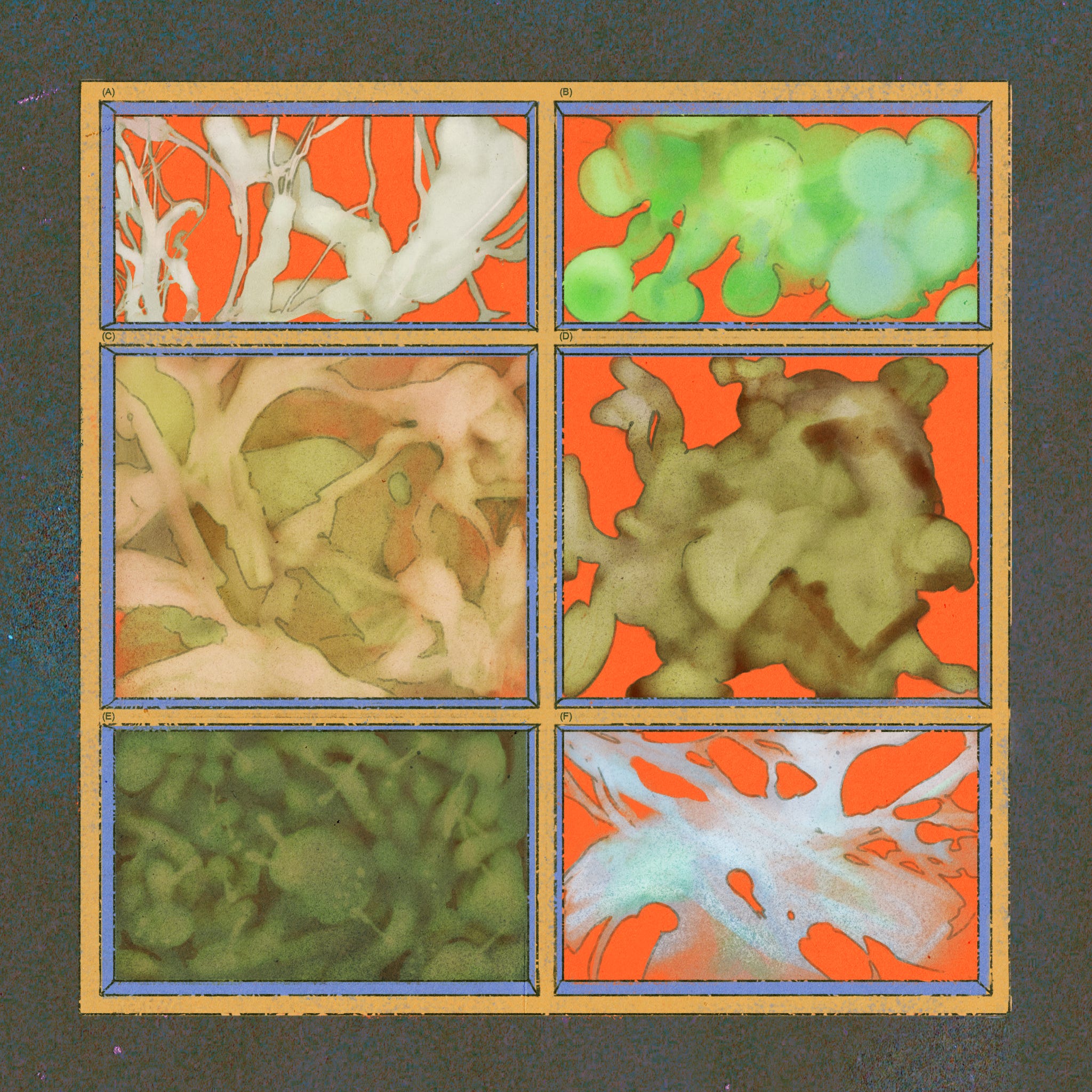
She loads the fungus’s genome on her pad, zooming in on the parts Giovanni has already selected for her. There it is. The fungus Jacob created is a strain of the Grifola frondosa, the Hen of the Woods, or Maitake. It’s the first edible fungus she, Giovanni, and their agritect partners successfully grew on the laboratory walls.
“Looks like the pathogen only targeted the oldest models of our walls,” Giovanni adds. “It’s spreading to the new ones, though. Maybe the hacker believes the old ones are the easiest to breach.”
Adri nods. She stares at Roberto’s face in the tiny photograph. Something stirs in the back of her mind. You don’t just leave your amulets lying around. You carry them with you. She touches the molar on her bracelet.
“Or maybe it’s just where he thinks the door is open…” Adri says.
You don’t just leave your amulets lying around. You carry them with you.
The first thing Adri does when she gets back to Maitake is hug Giovanni. His colleagues murmur, staring at her with worried expressions. Then she feels the tension in Giovanni’s arms. She leans back, staring into his eyes.
“Tell me!”
“Several districts of Maitake have been affected by Jacob’s strain,” Giovanni says.
“You know what we’ll have to do,” Adri says. He nods. Giovanni frowns but she doesn’t explain.
Jacob’s pathogen is the strain of fungus that gave birth to her town—and to her future. The fact that it’s this strain and not another makes everything a whole lot easier. They just have to find a way to contain it, either with the introduction of a new species that can outcompete it or by applying bacterial antagonists to inhibit its growth.
“Did you find the guy?” Giovanni asks.
Adri shakes her head.
“Not really. He’ll reveal himself in time.” Before Giovanni can reply, she adds, “Remember the political lobby we assembled in Riverden? To carve Maitake out of Rockstrak?”
“Oh, yeah. That was one hell of a battle.”
Making their idea a reality had been more like an all-out war than a battle. They had to turn from agritects into legislators, to convince Riverden’s companies to fund the walls and rebuild an entire town from scratch. To this day, they still have to lobby for their cause year after year, to convince those who make the laws and who provide the money that saving people from starvation is not only a worthy cause but the most noble of them.
“It was never a breach,” she tells Giovanni finally, remembering the pathogenic maitake creeping up the hostel’s walls.
“If it’s not a breach, what do you think it is?” Giovanni asks.
“An attempt at symbiosis.”

About the Author
Renan Bernardo is an author of science fiction and fantasy. He is a Nebula Finalist, Ignyte Nominee, Utopian nominee, and a Locus-recommended author. You can find his stories in several publications, including Clarkesworld, Reactor (Tor.com), Apex Magazine, Podcastle, Escape Pod, Samovar, Solarpunk Magazine, Translunar Travelers Lounge, and more. His collection of Solarpunk/Climate Fiction stories, DIFFERENT KINDS OF DEFIANCE, was published in 2024 by Android Press. His dark space opera novella, DISGRACED RETURN OF THE KAP’S NEEDLE, was published in 2025 by Dark Matter Ink and was a finalist for the Nebula Award.
About the Artist
Sajan Rai is an artist that enjoys world-building through non-linear illustrated poetry, as well as making preposterous comics. His commercial illustration has covered a variety of formats, such as Posters, TTRPG projects, book covers, vinyl artwork and apparel, amongst others. For leisure, Sajan enjoys reading, panicking, music and moving images.


Subscribe to read all of the stories in Tractor Beam’s Spring 2025 issue!
Know someone who is an avid sci-fi reader, passionate about climate, or loves to get their hands dirty in the soil? Spread the word, share our newsletter, or give us a follow on Bluesky and Instagram to stay connected. Let’s grow a better future together.
 | A guest post by
|