

When The Land Speaks
Can five animals preserve the permafrost?

You’re reading the fifth story in Thaw, Tractor Beam’s Winter 2025 issue. You can read Jeff VanderMeer’s guest editor letter and the remaining stories here. Subscribe to receive future Tractor Beam issues in your inbox as soon as they drop!
Story by: Jason Collins
Annotations by: Jeff VanderMeer
Art by: Varvara Nedilska
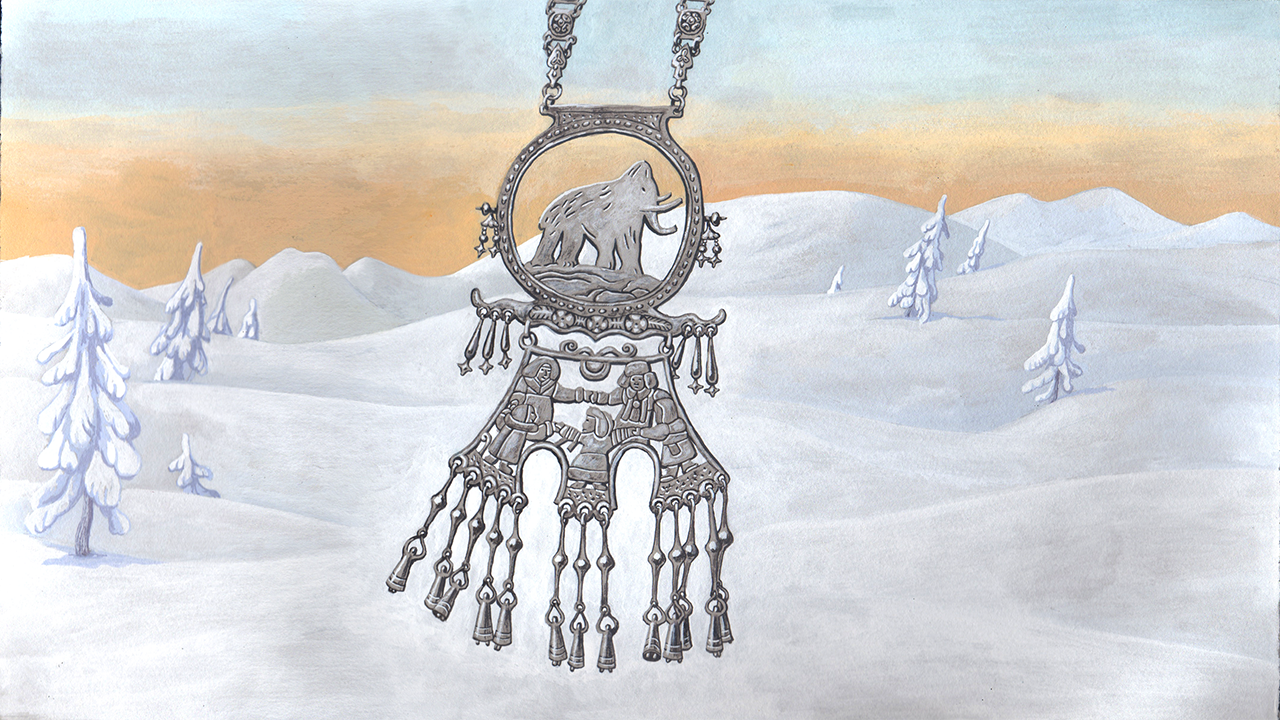
Sardaana woke to pounding on her cabin door and a muffled voice shouting her name. She jolted upright in her cot. Outside, Kolyma’s wind howled.
“Sardaana! Wake up!” It was her brother, Ayal. Something was wrong. Sardaana threw on her parka and stumbled to the door, wrenching it open against a drift of snow. Ayal stood there breathless, his fur hat askew. “The bull’s broken through the west fence,” he said in Yakut, words clouding in the frigid air. “He’s in the bog near the old spruce grove. Stuck!”
Sardaana grabbed her gloves and rifle, and sprinted after Ayal. Dawn was just a hint of deep blue along the horizon. In that faint light, the snow-covered tundra was flat and eerily endless, broken only by dark clumps of trees and shrubs.
As they ran, Sardaana caught sight of Dr. Chen and two other researchers up ahead, headlamps bobbing in the same direction. Word traveled fast. Ayal must have heard the alarm from the herders’ camp.
They reached the west end of the enclosure. Beyond it lay a marshy patch that usually froze solid in winter. Now, a hole gaped in the snow crust, revealing black mud and water beneath. The wire fence was trampled and sagging. The young bull mammoth was half submerged in the muck, and with every thrash of his trunk, he sank deeper.
Near the edge, Sardaana could see Dr. Chen crouched, field kit open, pencil already moving in the small leather notebook balanced on her knee. Inside, the community’s seasonal knowledge and oral histories had been flattened into lines of numbers, an academic dialect better suited for the classrooms in Yakutsk than a moment of crisis.1
“What do we do?” Sardaana said, trying to keep frustration from her voice. “Marisol,” she began, then corrected herself. “Dr. Chen. You can write it down later. Right now, we don’t have time.”
“It’s a thermokarst pit,” Dr. Chen said, voice tight. “Melting permafrost has literally caused the Earth to collapse. The ice looks solid, but it’s rotten from below.”
“Yes, and?” Sardaana snapped, the words coming out sharper than she intended.
“If he keeps struggling, he’ll widen the cavity. The more he moves, the more the sides shear away.” Dr. Chen met her gaze. “And if he tires out, if he goes down even once, he won’t come back up. Not in water this cold. Not at that weight.”
Dr. Chen stepped onto the marsh. The ice under her boot gave a sharp, hollow crack, and she froze.
Instruments were just another way of seeing what the community already knew...anthropology training had put Western language to knowledge held in the land itself
“Careful, Marisol!” Sardaana lunged, grabbing her arm. Fear flashed between them. If the rim gave way, there would be no way to pull him out.
Ayal and the others fetched coils of rope from the shed. The mammoth was about the size of a large elephant, maybe four tons. He was usually gentle, but Sardaana knew the fear of drowning could drive any animal wild. If he managed to haul himself out partway, it could be deadly.
She stepped forward, raising her palms outward. “Easy, boy, easy,” she called in low, even Yakut. The bull’s trumpeting quieted a notch, struggles slowing as he registered the familiar cadence of her voice. “He’s listening,” Dr. Chen whispered. “Keep talking.”
Sardaana hummed an improvised lullaby and edged closer. Slush swirled around the bull’s belly. He had managed to get his front legs on firmer ground, but his hindquarters were still stuck deep. With each heave, more water flowed in.
Heart in her throat, Sardaana stepped into the freezing mire up to her calves. Ayal threw her one end of a rope. She looped it carefully around one, thrashing front leg, keeping to the outside of his shoulder where he could not easily strike her. She tied a quick knot. Thank heavens her father had taught her to rope horses before she could walk.
“Alright, pull slowly!” she shouted.
Ayal and the scientists hiked the rope over their shoulders and leaned forward as one. For a moment, the bull groaned and sank deeper into the pit. The marsh sluiced around him. Sardaana’s knees buckled. Then, slowly, the rope began to tighten. Over his heavy groans, Sardaana heard Ayal shout for the group to step forward.
The bull kicked his powerful legs. With a wet sucking sound, he hauled himself up, first heaving his chest onto a shelf of firmer ground, then dragging his hindquarters clear of the mud, stumbling once, crashing through weak ice, then finally free of the pit.
The momentum sent Sardaana sprawling. Icy water flooded her boots and she gasped as the cold bit her legs. The mammoth stood trembling on the firm tundra, sides heaving. Dr. Chen approached him with caution. “He’s alright,” she assessed, relief clear in her voice.
Sardaana staggered upright. Ayal grabbed her arm to steady her. Her hands were shaking.
Dr. Chen looked at the steaming pool of muddy water and the broken fence. Sardaana watched as she held her bare hand just above the churned Earth, gauging the warmth. Sardaana had seen her grandmother test the land with the same careful motion for as many winters as she could remember.
“The ground just gave way underneath him,” Dr. Chen said. Dawn light was creeping in. Her face was etched with worry. “Warmer groundwater or underground methane release. Either way, this should not be happening now. It is January.”
She glanced toward the tree line, where the snow lay thinner and darker near the roots. Sardaana followed her gaze, and wondered if she too was thinking about the bent elder who, not two weeks ago, shook his head as he warned them about the pasture, warned them about unseen water channels running warmer beneath the snow. At the time, Dr. Chen had said she’d need more proof before making changes that could impact their results.
This wasn’t Yakutsk. Here the proof steamed at their feet.
“We can reinforce that fence today,” one of the other researchers, Luis, said, slinging the rope over a post. “And mark this zone off limits.”
Sardaana peered at the inky water. She did not need a graph to understand what it meant. The permafrost layer here was failing.
Dr. Chen gently took Sardaana by the elbow. “We should get you back to change before you freeze,” she said. “He’ll be here soon.”
Sardaana nodded. As she turned back toward camp, leading the shaken mammoth, she found herself rehearsing how she might explain this to Mr. O’Neill.
Welcome to our thriving Pleistocene Park, sir, where the permafrost is melting ahead of schedule, our data is less accurate than our old people, and we are hip-deep in mud…
A shiver ran through her that had nothing to do with her wet clothes. Today was off to a dreadful start.
****
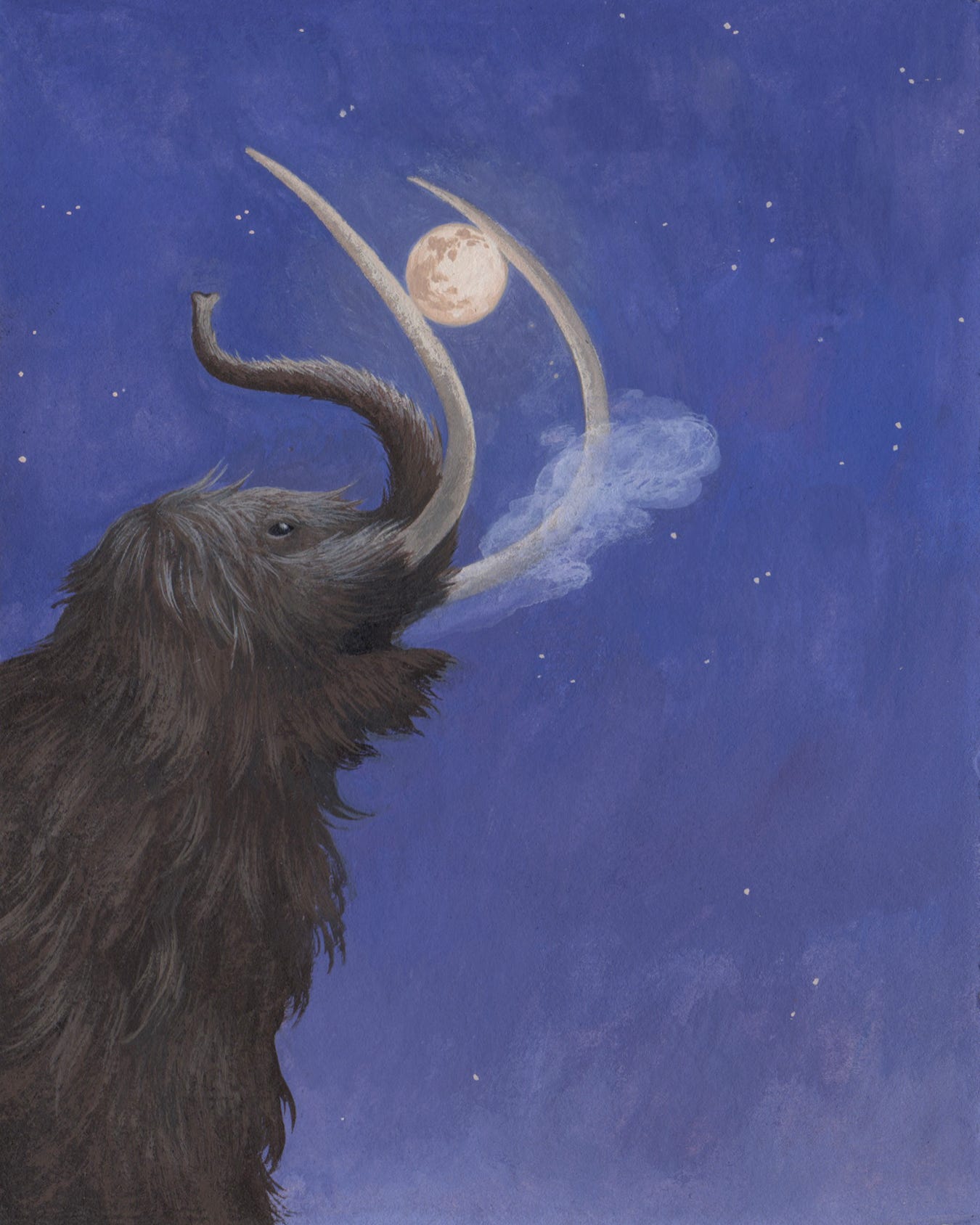
…this giant was only four years old, born from science and hope.
The previous evening, Sardaana trudged up the ridge overlooking her family’s winter pasture. The late-afternoon sky was a dim band of amber on the horizon, providing just enough light to see the shapes moving below. She paused to catch her breath, a plume of vapor curling from her lips into the frigid Yakutian air.
Down in the hollow, a massive, shaggy silhouette plodded slowly across the tundra scrub. A woolly mammoth, or something very close to one.
Sardaana marveled at the creature’s hulking form against the white expanse. Tufts of thick russet fur stirred in the polar breeze, and curved ivory tusks, each as long as a man, reflected the faint glow of snow.
This was a Sælii, as her grandmother called them in Sakha; one of the ancient giants that once roamed this land. Except this giant was only four years old, born from science and hope.
“Hey, little lady,” Sardaana called softly, clicking her tongue the way she did with her reindeer. The young cow raised her head, large ears flapping forward at the familiar voice. Her dark eyes reflected the dusk as she lumbered toward Sardaana. Despite the elephantine size, the creature’s curiosity reminded Sardaana of the orphaned foal she’d raised years ago: gentle, playful, and trusting.
Sardaana slid down the ridge to meet her at the fence line. The wire was temporary. Just enough to keep the herd in range, though truthfully, these mammoth-elephant hybrids seldom strayed far. The cow, named Kholaya by Dr. Chen after the Kolyma River, extended her trunk in greeting. “You know I can’t resist you, greedy girl,” Sardaana laughed as the prehensile tip brushed over her wool parka and probed at the pouch of dried lichen treats on her belt.
As the mammoth crunched contentedly, Sardaana leaned against her warm, hairy bulk. The young cow’s body heat radiated like a living furnace, a welcome comfort in the bitter twilight. Sardaana closed her eyes for a moment. It was quiet. There was only the slow shifting of Kholaya’s weight and the gentle sigh of wind through naked birch branches poking above the snow.
Sardaana was a child when she first heard elders speak of the Sælii, the Earth-Bull that lives beneath the frozen ground. In Yakut legends, mammoth bones unearthed by the thawing of permafrost were believed to be the horns of a giant bull that roamed the underworld. Disturbing those remains without ceremony risked great misfortune.
So, years later, when the scientists brought Kholaya and her kin to this valley, Sardaana’s grandmother insisted on a fire-feeding ritual the night the first calf arrived, performed at the edge of the pasture as the generators hummed and the snow fell softly around them. She offered milk and juniper smoke to soothe the spirits of the tundra. Only then did she proclaim that the Winter Bull of legend had returned, not as an omen of doom, but as a guardian of the land.
Dr. Marisol Chen had watched the ritual with analytical respect. A trained anthropologist, she stood slightly apart, hands tucked into her coat pockets, observing each step carefully. Later, she told Sardaana that she had asked the community elders the meaning behind each action and showed her the notebook where she wrote down their answers alongside soil readings and animal tracks. It was all part of the scientific process, she explained. Not just the mammoths, but the ritual too.
That night often returned to Sardaana when she stood beside Kholaya. She preferred to think of her not as an experiment or a curiosity, but a living ally to the wounded permafrost. Us too, she’d say silently. We’re not just part of your experiment.
Sardaana gently patted the mammoth’s flank. Under her palm, she felt slow, deep breathing and powerful muscles shifting beneath thick fat and fur. Four years earlier, this creature had existed only as a collection of cells in a laboratory freezer, more idea than animal. Now she was here, nibbling lichen from Sardaana’s hand and compacting the snow with each step, just as the long-lost herds once did. The elders always said the land remembered its own patterns. Watching Kholaya move, Sardaana could almost believe the Earth recognized her.2
A sharp gust of wind whipped a veil of powdery snow across the ridge, and dusk deepened quickly into night. Sardaana reluctantly pushed herself off Kholaya’s warm side. “Time to get back,” she said. The mammoth snorted, a puff of hot breath in the cold, and followed as Sardaana started walking along the fence.
Sardaana’s task this evening was to make sure the herd stayed within the rewilding zone and to check that none had broken through the barriers. Her people and Dr. Chen’s project team had cleared about twenty square kilometers of tundra for the animals to roam, just a fraction of the ancient grazing lands they were meant to revive.
As she walked, Sardaana scanned the snowy expanse for the rest of the herd. Besides Kholaya, there were four other mammoth-elephant hybrids in this first generation: two older females nearing a decade old, a young bull around six, and the smallest, a calf barely eighteen months old who had been born right here in the Arctic. The baby, Tuutik, was a symbol of hope, proof that life could bloom in the permafrost.
Tuutik stayed close to his mother, the matriarch Sura, but he was curious and surprisingly quick on his feet. Sardaana spotted the calf’s shaggy shape trotting after his mother’s broad shadow near a stand of dwarf willows. All seemed calm, but still she paused, reflexively whispering a blessing for young animals: one she had learned long before she ever learned to read a temperature graph.
Shaking her head at the habit, Sardaana tugged her fur-lined hood tighter and turned toward the glow of electric lights at the field station. The “station” was little more than a cluster of prefab cabins and yurt tents nestled against a rocky outcrop, but in this stark wilderness, it was a beacon of human life.
She knew Dr. Chen would still be awake at this hour, hunched over soil samples and climate monitors. She had come from half a world away to live in Sardaana’s community and chase this audacious experiment. She appreciated Dr. Chen, her work and the relationship the two of them had built over the years. And yet, Sardaana sometimes caught a hesitation in her gaze, as if Dr. Chen was still learning how close to stand. Even after all these years, when she spoke of her work, she spoke about bridging cultures and gathering lived experiences from the elders. As if she were, at heart, an observer first and a neighbor second.
Sardaana sometimes found herself holding back a quiet frustration at the growing archive of notes and recordings taken from village elders. Seasonal changes. Hand-transcribed maps. Wind patterns and animal paths painstakingly described and carefully preserved. The knowledge was offered freely, but catalogued this way it felt like something had been taken.
By the time Sardaana reached the camp, night had settled fully and a pale ribbon of aurora shimmered green on the northern horizon. She stomped snow from her boots and pushed open the door of the largest cabin, which served as both lab and living space. A wave of heat from a crackling stove and the smell of strong tea flooded over her. Dr. Chen glanced up from a desk strewn with monitoring equipment and notebooks. “You’re back.”
She had pulled her long black hair into a loose braid and was wrapped in a thick wool sweater two sizes too big. Despite the chill outside, Dr. Chen’s cheeks were flushed warm from hours spent bent over her microscope and data readouts.
Sardaana unwound her scarf. “All five are accounted for,” she reported. “Kholaya tried to charm extra treats out of me again. Tuutik was behaving, for once.”
“That’s good,” Dr. Chen stood and stretched, wincing as her spine popped. “I keep waiting for him to figure out how to slip under the fence.” She motioned Sardaana over. “Come, take a look at this.”
Sardaana joined Dr. Chen at the desk. A tablet screen displayed a graph zigzagging upward. “This is the permafrost temperature at one meter depth,” she explained, tapping a red line. “It has gone up almost half a degree since last year.”
“Even in winter?” Sardaana asked, frowning.
Outside, the nights were well below freezing. Dr. Chen’s lips pressed into a thin line. “Especially in winter.”
Welcome to our thriving Pleistocene Park, sir, where the permafrost is melting ahead of schedule, our data is less accurate than our old people, and we are hip-deep in mud…
She reached for a thermos and poured hot tea into a tin cup for Sardaana, then refilled her own. “That is the part that worries me.” As Sardaana wrapped her fingers around the steaming cup, Dr. Chen continued, “Thick snow acts like a blanket. It keeps the soil from feeling the true cold. The deeper layers of permafrost are not reaching the temperatures they once did. And when summer comes—”
“—they thaw faster,” Sardaana finished. She smiled. When Sardaana had come home two years ago after earning her degree in environmental science at Yakutsk, she’d been determined to unite modern research with the ancestral wisdom of her people. This project had given her that opportunity; other villagers’ claims that the Sælii were going against tradition could not quash her elation. “We need the mammoths and musk oxen and all the others to punch through the snow, break up the moss, and let the deep cold in,” she’d recited like a mantra. It was what the scientists had pinned their hopes on: resurrect the ancient steppe ecosystem so the permafrost soil could stay frozen and keep its carbon locked away.
Most of the approaches in the project were not new. Dr. Chen’s instruments were just another way of seeing what the community already knew. Her anthropology training had put Western language to knowledge held in the land itself, this time shaped by outsiders with more money and their own agendas.
Dr. Chen gave her a tired, approving look. “I’ve explained this to the oversight committee already,” she said. “In theory, a restored grassland with heavy winter grazing should significantly lower soil temperatures. That’s what the models show.” She sighed and traced a dip in the graph, where a brief cooling had occurred. “But we are still in the early days. Five animals can’t transform twenty square kilometers on their own. Not yet. We need more time, and more megafauna.”
Sardaana took a slow sip of tea. “Do we have more time?”
Dr. Chen did not answer. Outside, a gust rattled the cabin’s frosty windowpane. At last, she said, “The board at Arktos Biogen isn’t happy with the progress reports. They funded the de-extinction program, and are expecting quick results from this pilot site.”
“Quick results?”
Behind closed doors, Sardaana worried that Dr. Chen’s early enthusiasm had begun to wane. Nothing in the Arctic happened quickly, especially not healing. Her grandmother always said the land responded to patience, not pressure. “Did they think thawing permafrost would just refreeze overnight because a mammoth showed up?”
Dr. Chen shook her head. “Some of them might have. Or at least they hoped for clear data by now that our approach is cooling the ground. We are seeing promising grass growth, higher soil carbon, and lighter snow cover in cleared patches. Just not dramatic enough yet for the spreadsheets.”
“They are sending their representative tomorrow. A Mr. O’Neill. He will assess whether to continue funding. I am worried, Sardaana. If he decides to pull out, we could lose everything. They could even claim the animals.”
Sardaana set down her cup. “Claim the animals? But Kholaya, Sura ––” For Sardaana, this was more than a project, this was her home; the thought of the mammoths being hauled off in crates, shipped to some faraway compound made her chest tighten.
“Legally, Arktos retains ownership of the hybrids,” Dr. Chen reached out and placed a hand on Sardaana’s shoulder. “They promised them to us for rewilding, but if the project is deemed a failure, who knows what they will do. Maybe sell the idea to some theme-park venture.”
Sardaana lowered her eyes. She thought of Tuutik, the first mammoth born on Siberian soil in millennia. He had taken his first breaths on a frigid spring morning with Sardaana and Marisol crouched by Sura’s side, cheering when he finally stood on wobbly legs. How could anyone look at moments like that and judge them by numbers alone?
“There has to be something we can show him,” Sardaana said, the words sharper than she meant them to be. “Some way to prove this is working.”
Dr. Chen rubbed her brow. “I will present all our data,” she said. Then, after a pause, she added, “But I want you to share what you have observed from the herder’s perspective. Sometimes a real story carries weight that graphs do not.” She gave Sardaana a small, tired smile. “You have a way of cutting through the nonsense, you know.”
Sardaana barely managed a smile. This was the plan, then. A visiting executive, a fragile program, and her lived experience offered up as ballast. She was not sure how a girl barely twenty-one was supposed to sway a businessman whose decisions would ripple far beyond this valley.
She finished her tea and stood. “I should get some sleep. You should, too, Marisol.”
Dr. Chen nodded, her attention already drifting back to the data on the screen. “In a minute. I just want to double-check the thermal camera feeds from this afternoon.”
Outside, the cold nipped Sardaana’s nose and cheeks, but she lingered, gazing at the vast dark sky. She made a silent plea that the spirits of the permafrost were actually watching over this frozen garden of theirs.
****
Mr. Desmond O’Neill arrived in a flurry of wind and noise, stepping down from the chopper with a thick parka and an alert, appraising gaze. Sardaana stood beside Dr. Chen to greet him, both of them still weary and mud-stained from the early rescue. They had only managed a brief rest and a change into dry clothes. The broken fence was patched for now, but signs of the morning’s activity lingered in the churned snow and the uneasy shifting of the mammoth herd in the distance. They’re skittish.
O’Neill moved with efficient confidence, but there was nothing rushed about him. A tall, sharp-featured man in his fifties, he carried the practiced calm of someone used to making difficult decisions. “Dr. Chen,” he said warmly, offering a small nod before turning to Sardaana. “And you must be—ah. I’m afraid I don’t have your last name in my notes.”
“Just Sardaana is fine,” she replied evenly, shaking his gloved hand. His grip was firm, steady. He met her eyes when he spoke. Despite herself, Sardaana liked him.
As they set off on snowshoes along the packed trail, O’Neill glanced toward the distant mammoths. “How are they faring in this environment?” he asked, a genuine curiosity threading his voice.
“Very well overall,” Dr. Chen replied. “We’ve seen them uproot brush and churn up snow just as anticipated.” She added, “We’ve seen consistent winter foraging and snow-compaction behavior. These modern specimens exhibit patterns that match the ways that the old herds moved across the land as seen both in visual and narrative storytelling.”
Sardaana couldn’t help adding, “They love it here. This is their home now, same as it was thousands of years ago.” She pointed toward Sura and Tuutik, who stood side by side not far off, watching the strangers warily.
O’Neill gave her a small smile. There was a faint, thoughtful crease in his brow. “Sentiment aside,” he said gently, “the core question the board will ask is whether their presence is materially impacting the permafrost metrics.”
Sardaana held his gaze a beat longer than necessary. “Right,” she said. “The spreadsheet question.”
He paused before continuing, choosing his words with care. “My ability to recommend your project hinges on seeing measurable evidence of cooling, carbon capture, and the climate benefits that were originally proposed.”
Dr. Chen cut in. “Of course. We have data from soil probes and temperature sensors. It shows some encouraging trends, though it’s early.” She tapped the notebook hanging from her pack. “We also keep records of seasonal signs shared by the community. Those shifts line up with what the instruments are showing.”
O’Neill listened. A shadow passed across his face, not unkind. Sardaana wondered what pressure he carried from beyond this valley. When he finally spoke, his voice held a measure of restraint. “I hope so. I’ll be honest with you, the board has been nervous about the pace. They’ve asked me to find out if this landscape is changing fast enough to justify the investment.”
As they walked, Dr. Chen described the increase in grass cover, the changes in albedo resulting from cleared snow, and the nutrient cycling provided by the animals. Sardaana chimed in with her observations of how the herd’s grazing had transformed patches of scrub into open meadow last summer.
They reached the site of that morning’s sinkhole. The ground was a churn of mud and ice crust, cordoned off with bright flags. Sardaana’s stomach tightened. The air still smelled of raw earth. The ease that had slowly unfurled across O’Neill’s face slipped away. He raised an eyebrow.
“What happened here?”
Dr. Chen answered frankly, “We had an incident a couple of hours before you arrived. One of the juveniles broke a fence and wandered onto unstable ground. A patch of permafrost collapsed.” She crouched briefly, brushing her fingertips over the disturbed soil, “The way it fractured looks a lot like the midwinter thaw stories the elders told us to watch for.”
“It’s not just a story,” Sardaana snapped.
“Yes, well, if we had a larger herd to trample the snow and promote a hard freeze,” — Dr. Chen hesitated, adjusting her wording — “and if we follow the grazing patterns the community says once kept these ridges stable, we could slow these collapses.”
O’Neill held up a hand. “I understand the theory, Dr. Chen. The board isn’t convinced we can scale this up in time to make a difference. We have to ask if this is the best use of our resources.” O’Neill’s face stiffened, not with disdain but with something like fatigue. “I don’t get to decide whether it matters,” he said quietly. “Just what I can defend to people.”
Sardaana felt a surge of frustration and panic. “So that’s it? You’ll take the mammoths and walk away?”
She gestured broadly at the expanse, the gleaming snow, the dark wound of the sinkhole, the herd of mammoths, and the endless sky beyond.“This place is fighting for our lives, and we’re fighting to save it,” she said.
“Sardaana—” Dr. Chen started, but before she could interject, Sardaana rounded on her. “Who are either of you to decide the value of that?”
A low rumble passed under their feet. Sardaana felt a vibration in her boots, as if a great engine had started deep in the Earth.
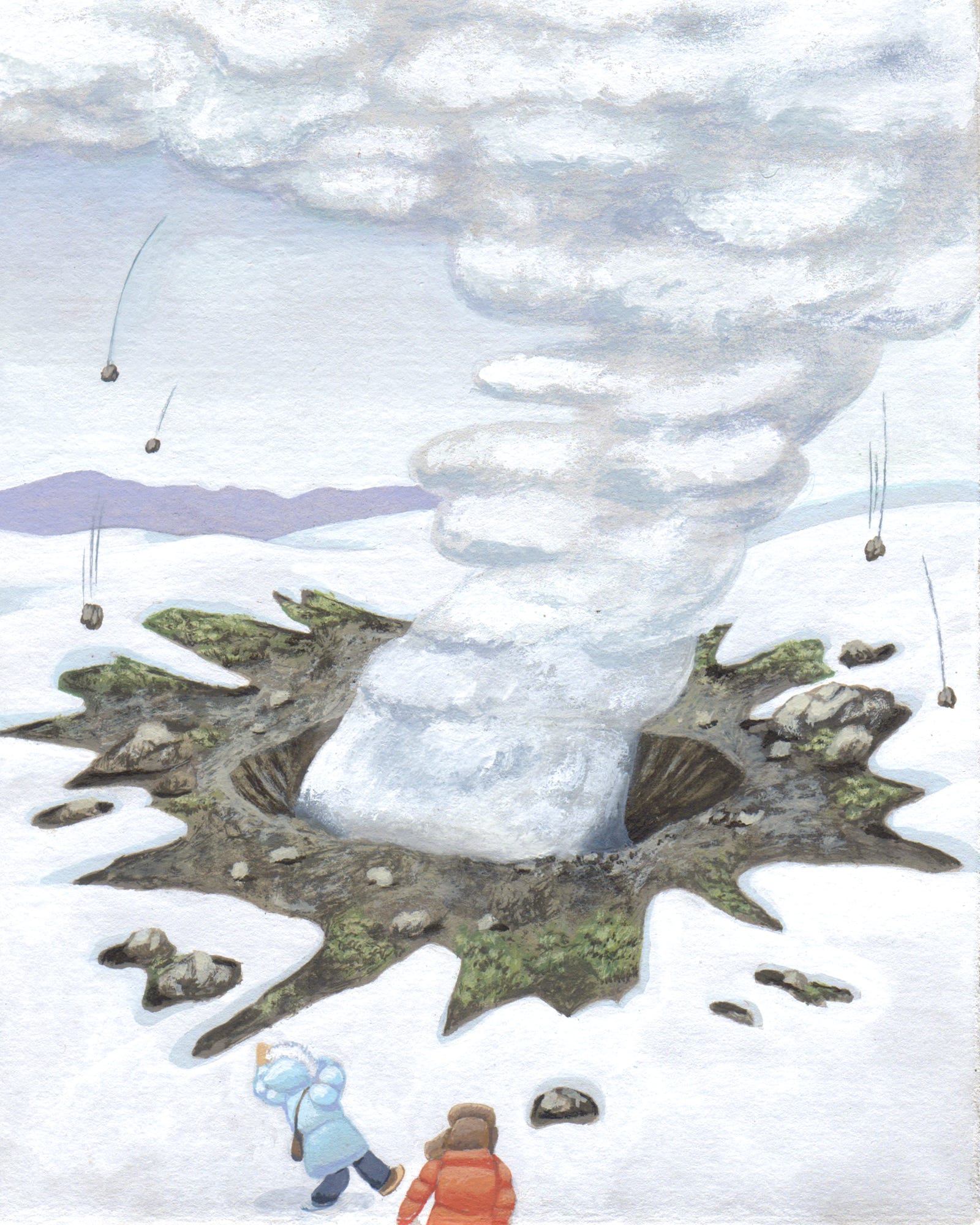
A crack rang out. Sardaana whipped her head around. A few dozen meters beyond the broken fence, a section of frozen ground heaved upward. The bog where the bull had been trapped was now shuddering unnaturally. For an instant, everything was suspended in eerie silence.
The Earth erupted. A plume of soil, ice, and gas blasted into the air. Sardaana stumbled backward as a shockwave rippled through the ground. She hit the snow hard, stunned, ears ringing.
For a moment, she could only gape. Where the bog had been, there was now a raw gaping crater belching foggy breath, methane, and water vapor venting from the depths. Chunks of permafrost rained down like clods of black snow.
Sardaana’s hearing faded back amid a chorus. The terrified trumpeting of mammoths, the distant bellowing of reindeer, shouts of the research team back at camp.
She scrambled onto her knees. “Marisol!” she coughed. She twisted frantically, her anger from moments before now replaced by fear.
Sardaana spun to the mammoths, looking for the familiar black braids. The giants were in disarray; Kholaya stomped, Sura trumpeted frantically, and Tuutik–she scanned the horizon and caught sight of a small dark shape fleeing westward, beyond the pasture’s boundaries—Tuutik was heading toward the frozen river beyond the ridge.
Sardaana dashed to the snowmobile parked near the fence, pausing at the last minute to grab that morning’s discarded rope. She heard shouting behind her, but the words were lost to the ringing in her ears.
The vast expanse of the Kolyma River lay ahead. In deep winter, it was a flat, white plain, a highway of ice stretching to the horizon.
Tuutik scrambled down the bank onto the river’s frozen surface. Out on the ice, the calf floundered, skidding, before his small bulk broke through a thin crust of refrozen snow. He was up to his chest in slush, frigid water pooling around him.
If the ice couldn’t hold him, there was no way she could reach him on the snowmobile.
She grabbed the rope and ran, half-sliding, across the surface. The ice beneath her boots was slick and uneven, water skimming across it in shallow sheets. She forced herself to move lightly, distributing her weight as her father had taught her when crossing uncertain ground during spring hunts.
When Tuutik was twenty meters ahead, Sardaana dropped to her knees and crawled. The cold seeped through her clothes immediately, leaching heat from her thighs and palms. She ignored it. She needed to reach Tuutik.
“Easy, Tuutik, easy,” she murmured gently. The calf’s eyes rolled toward her. He let out a frightened baby’s wail, still trapped in the slurry of half-frozen water pooling over the ice. His legs scrambled uselessly, churning the slush further with every panicked movement.
She inched closer. She was within arm’s reach of his flailing trunk. “It’s okay,” she whispered, praying he wouldn’t jerk suddenly. From her belly, she uncoiled the rope. There was nothing solid to anchor it to out here, nothing but flat, flooded ice, so she looped it around her waist. Little by little, she slipped the rope under Tuutik’s chest, using the tension of the line rather than lifting him, guiding it behind his short legs. If she could pull him just enough to reach firmer ground—
He stopped struggling for just a moment as Sardaana carefully passed the rope under and around him, fingers numbing in the freezing water. She gritted her teeth against the pain.
Finally, the rope was looped around his middle. Sardaana leaned back instinctively, boots skidding on the slick surface as she searched for purchase that wasn’t there.
“Alright, Tuutik. One big pull.”
She held the rope tight. If she could do it this morning, she could do it again now. And for a moment, the calf seemed to sense her intention. But before she could say another word, he surged forward in panic, heaving his forelegs onto solid ice with a desperate grunt, then kicking hard with his hind legs. The rope snapped taut.
The pull was not sharp but crushing, a relentless drag. Water surged over the ice in a fast, shallow sheet, flooding her knees and thighs and sweeping her feet out from under her. She went under with a soundless gasp, the cold wrapping around her legs and waist and pulling her sideways. The rope burned against her middle as Tuutik’s weight shifted again.
She clawed at the ice, fingers skidding uselessly across the wet, stone-slick surface. The current dragged at her boots, tugging her farther from the edge. Her body felt clumsy now, slow, already betraying her. Tuutik kicked again in blind panic; the force nearly broke what little grip she had left.
A terrible clarity cut through the fear. He didn’t know her. The calf she had sung to, fed, and watched grow was trying to live, and in that, he was as dangerous as the river itself. Her grandmother’s stories flickered through her mind, stripped of their comfort now. Not guardians. Not omens. Earth-bulls that crushed anything that stood too close.3
Not like this, she thought.
Her grip failed.
Something shifted above her. A sudden, violent tug seized the back of her parka. Sardaana felt herself sliding across the ice, dragged by a force stronger than the current.
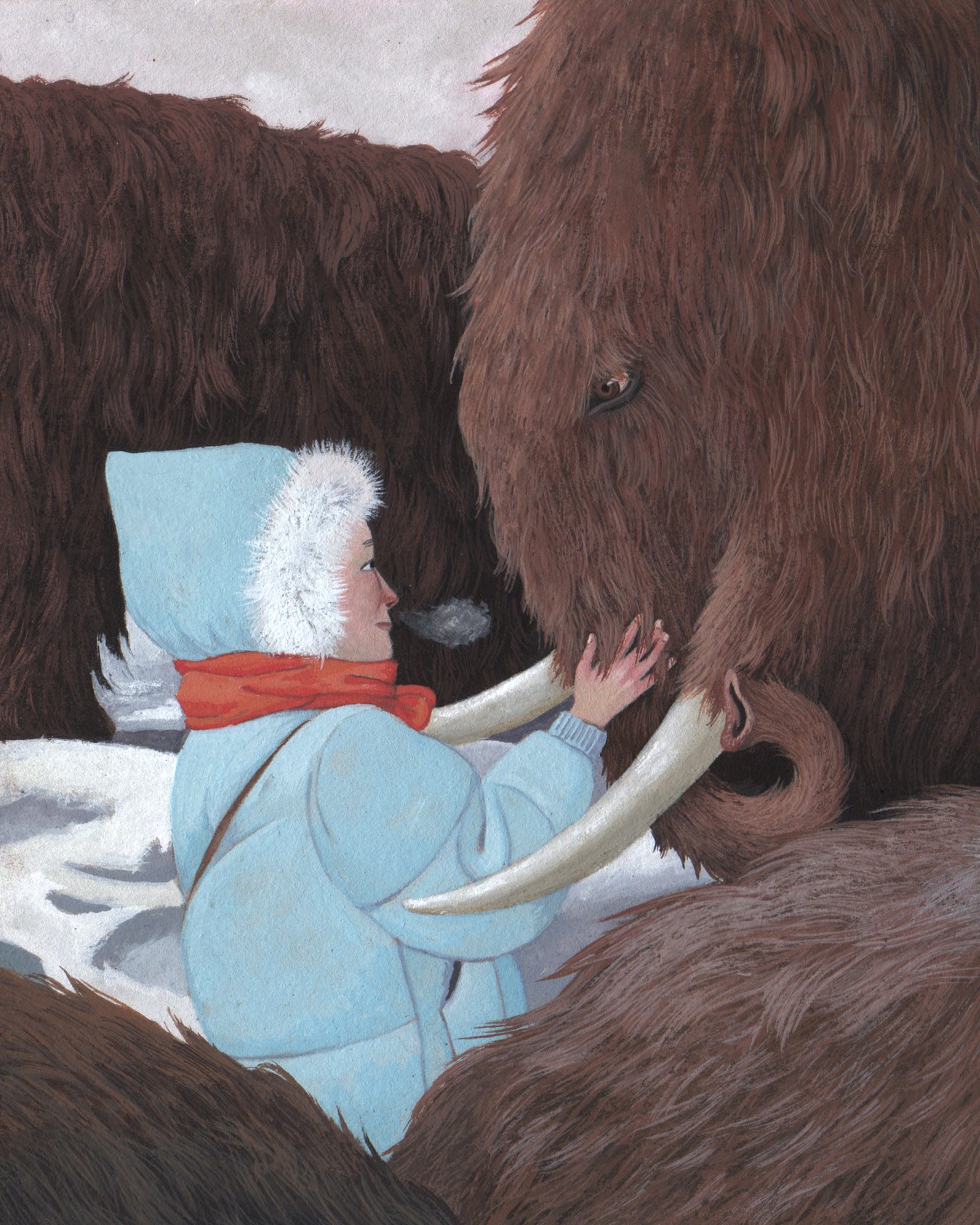
She coughed, snow scraping against her cheek, breath tearing into her lungs. A mammoth loomed over her, feet planted wide on the ice. With a mighty heave, Sardaana was pulled onto safe ground.
The cold had sunk deep into her bones. But she was alive. Through blurred vision, she saw Kholaya standing over her. The mammoth hovered, trunk gently nudging Sardaana’s side as if checking on her. A wet laugh bubbled out of Sardaana’s chest.
Behind Kholaya, Sura trumpeted anxiously.
Tuutik, now free, stumbled toward his mother. Sura swept her calf under her belly with a fierce, protective rumble. Only once Tuutik was safe did the matriarch turn her attention to the sodden human lying on the ice.
By then, Marisol and Ayal were upon them. Marisol flung herself to her knees and gathered Sardaana into her arms, wrapping her in a blanket. “Sardaana! Sardaana! We’ve got you.” Marisol’s face was a lattice of tears, dirt and small cuts. Sardaana had never been so happy to see her.
She held Sardaana tight, sharing her body warmth. For once, Marisol did not look back at the river, or the mammoths. She did not look at the instruments clipped uselessly to her pack. She looked only at the person in front of her: Sardaana.
Sardaana’s teeth chattered and relief flooded her. She let her head rest against Marisol’s shoulder as Ayal checked the rope burns on her waist and swore under his breath about foolhardy sisters.
A little ways away, Mr. O’Neill stood watching, cradling an injured arm, expression unreadable. He looked at the crater and the frightened herd. He nodded to her.
“This place is fighting for our lives, and we’re fighting to save it.”
****
A week passed. Sardaana stood again on the ridge. Below her, the permafrost crater remained a stark scar, though recent snow had softened its edges. Kholaya and Sura crossed near it fearlessly, the matriarch leading her calf and the young cow following, trumpeting as if defying the broken Earth.
Mr. O’Neill had departed at first light. His arm was in a sling, and he moved stiffly, but still managed a smile. He made no promises. He only said, carefully, that he would “take the full picture back to the board.”
Marisol came up beside Sardaana and they shared a quiet smile. In the west, the sun was brushing the horizon in a prolonged Arctic sunset, casting the snow in hues of gold and rose. The beauty felt complicated, a kindness offered too late.
“Look,” Marisol whispered, pointing.
On the far side of the pasture, tiny green shoots were poking through a patch of soil the mammoths had trodden. Fresh grass, improbably early and stubborn against the cold. Sardaana felt a quiet thrill at the sight. It might be one small sign among many that their frozen garden could one day grow and flourish. Or it might vanish again under the next warm spell.
Marisol took Sardaana’s hand. “What is it your grandmother always says — the land always answers?”
Sardaana smiled. “Just not quickly. And rarely in full sentences.”
This is such a telling moment, both in the general sense that there is data, or fact, and in how data exists in motion in a very specific location or landscape, and how systems of knowledge developed over time and drenched in experience take on additional layers and entanglements of fact and data that cannot be replicated in any other way. I’m also reminded of how, in a totally different context, Western scientists used to be generalists and sometimes reported their findings using poetry, or the “philosophical tale,” as a better delivery system than the standard lecture. Now, more than ever, we need deep knowledge and holistic, localized approaches to our many problems. (Annotation by Jeff VanderMeer, Guest Editor)
On an Earth with rapidly shifting climate and ecosystems due to catastrophic human intervention in the landscape and Earth systems, there is definite controversy about whether far-distant past extinctions should be reversed or whether we should focus on the present day and preserving what we have now. But, in the context of fiction, we can usefully extrapolate a reversal of extinction, and what cultural, social, and nonhuman contexts should accrete around that resurrection, and what purpose it might serve. The point of fiction sometimes is not to show something that might happen, but, by using the form as a laboratory, to show an act that may never happen, and yet still show us something useful about the present. (Annotation by Jeff VanderMeer, Guest Editor)
I appreciate that the story acknowledges that the nonhuman has its own agency, its own agenda, and that even in a somewhat controlled, experimental situation, we are not necessarily in control, nor should we be. (Annotation by Jeff VanderMeer, Guest Editor)
Bringing Sci-Fi Down to Earth…
Tractor Beam is a soil-based Sci-Fi publication that explores speculative ideas around farming, food, earth sciences, and beyond, imagining a positive future here on Earth (in the earth). Our goal is to connect people to regenerative agriculture and soil health in a meaningful way. We call it “soilpunk.”